





There are very few moments in adult life quite like being handed a sterile plastic cup and directed toward a small, dimly lit room with the instruction: "We need your sample in twenty minutes, please."
For most men, providing a semen sample for fertility testing is a completely unprecedented experience. It sits at a bizarre intersection of clinical medicine, intense personal performance anxiety, and awkward logistics. Suddenly, something you have likely become quite well practiced at in complete privacy becomes a high-stakes, timed diagnostic event.
We talk to men every single day who feel anxious, embarrassed, or completely overwhelmed by this stage of the fertility journey. So, let’s break the stigma and open up the conversation. Let’s lose the awkwardness, and talk about what giving a sample actually involves, how to prepare for it and what to do if things don’t quite go to plan on the day.
The sweet spot of abstinence and being prepared
Before you even step foot inside a clinic (or attempt a sample at home), you have to time things just right. This comes down to the abstinence period, the amount of time you should refrain from any sexual activity or masturbation before providing your sample.
The current WHO guidelines recommend between 2 and 7 days of abstinence which is actually a huge window and not necessarily the most helpful when it comes to getting a reliable result.
Other guidelines recommend a tighter window and for us we suggest between 2 and 3 days but not greater than 3 days.
If you ejaculate too soon before the test (under 48 hours), your sperm count and sample volume might be artificially low simply because the production factory hasn't had enough time to restock.
If you abstain for too long (more than 3 days), your overall sperm count might look high on paper, but the quality suffers. Older sperm sitting around begin to degrade and can increase oxidative stress, leading to lower motility and increased sperm DNA fragmentation. This is why we always advocate for men to be ejaculating regularly.
Think of it as finding the "Goldilocks zone", not too fresh, not too stale, but just right.
Beyond timing your abstinence, the few days leading up to your test matter just as much (although the sperm you produce on the day of test have been 3 months in the making). Sperm production is a sensitive biological process, and your body responds directly to how you treat it:
Stay well hydrated: Dehydration can negatively impact your overall semen volume. Make sure you are drinking plenty of water in the 48 hours leading up to your appointment.
Prioritise sleep: High cortisol (the stress hormone) and chronic sleep deprivation can quietly wreak havoc on your hormonal balance and sperm parameters. Try to log a few solid nights of rest before the big day.
Keep things cool: Avoid saunas, hot tubs, tight cycling shorts, or resting a hot laptop directly on your lap in the week leading up to the test. Excessive heat is kryptonite for sperm production (to be fair this should be standard practice anyway).
Preparation, Practice, and "Pot Shock"
If you have never ejaculated directly into a narrow plastic container before, it is worth acknowledging a basic truth: the geometry is surprisingly challenging.
Because of this, we are more than happy to post you a free sterile sample pot so you can have a low-pressure practice run at home first. Getting comfortable with the logistics in the comfort of your own home eliminates a huge amount of “getting it in the pot” anxiety when the real day arrives.
When you get your hands on a sample container, the very first thing you will notice is its size. Almost every man is surprised by how big the pot is (usually 125ml) and this frequently triggers a wave of panic.
Let’s clear this up right now: you are NOT expected to fill the pot.
In fact the average human ejaculate volume is only between 1.5 and 5 millilitres which means your sample will likely only cover the very bottom or fill barely 10% to 15% of the container. That is completely normal and expected so don’t be disappointed or concerned if it doesn’t look like much.
In a panic, some men assume they need to "try harder" or provide more. But attempting a "double ejaculation" in one sitting, or worse, trying to top up the cup with water or other liquids, will completely destroy your test. The lab only needs one single, natural ejaculate.
When collecting that sample, there is one non-negotiable golden rule: you must catch the whole sample.
The initial burst of the ejaculate contains the absolute highest concentration of sperm often up to 75% of the total sperm count. If you miss the pot at the very beginning or at any point during ejaculation, the sample will not reflect your true fertility profile. In fact, for many accredited laboratories (including ours at testhim), missing any part of your sample means the test cannot be processed at all, and you will have to repeat the process on another day.
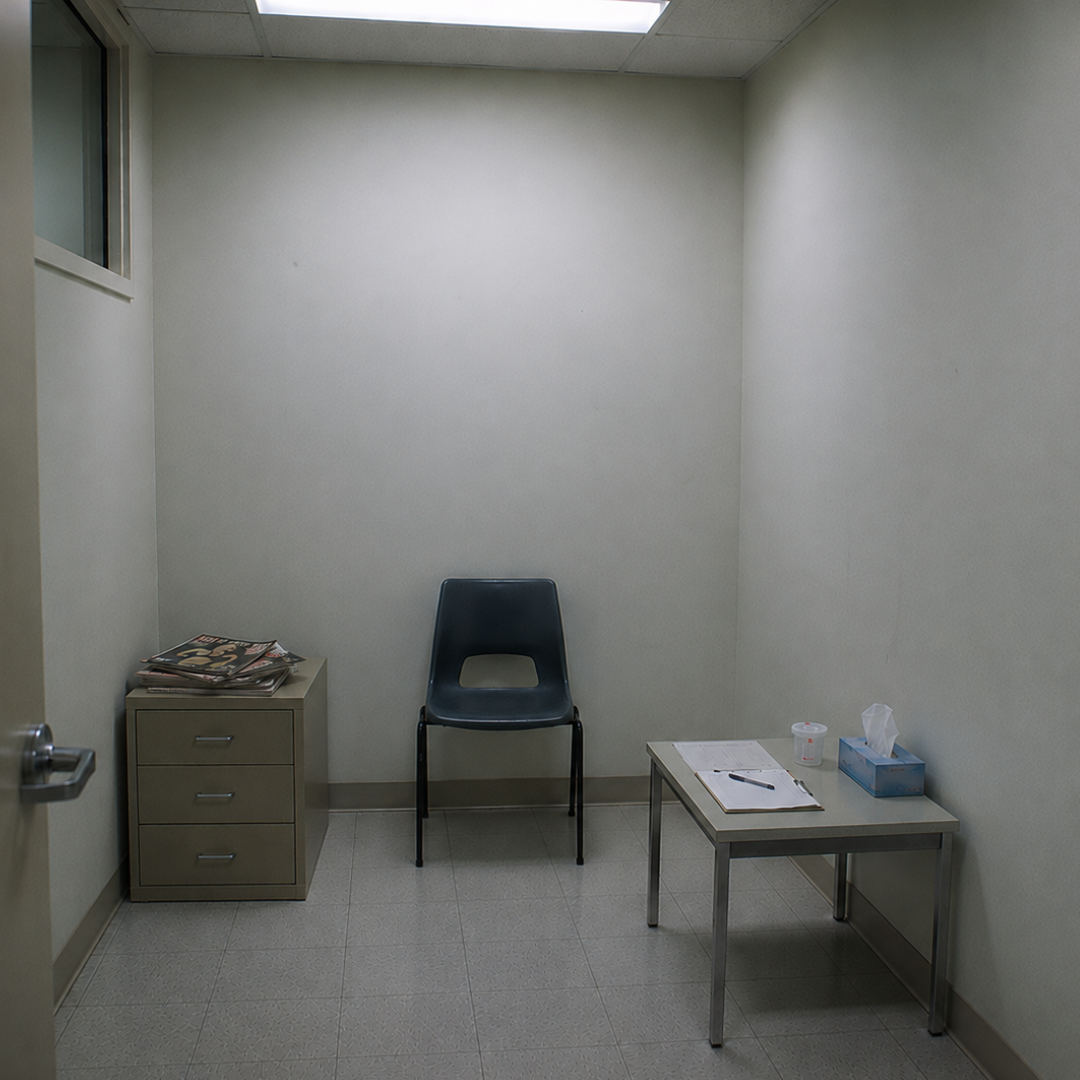
Inside the clinic: Wi-Fi, magazines, and the reality of "Bad rooms"
One of the most common worries men have is what the clinic environment will actually be like.
The reality varies wildly and if we are being completely honest, some of the rooms out there are less five-star spa and more comedy of errors.
At the high-end, some private fertility suites offer plush leather armchairs, dimmable lighting, soundproofing, and tablets loaded with high-definition media. Unfortunately though, we have heard every war story imaginable from the frontlines of NHS and private testing:
The repurposed disabled loo: It is shockingly common for clinics to use an ordinary accessible toilet down a busy corridor. Trying to get into the zone while staring at a red emergency pull-cord and a clinical yellow sharps bin is a unique mental challenge.
The paper-thin walls: We’ve spoken to men who were trying to focus while hearing nurses chatting about their weekend plans right outside the door, or worse, listening to the hum of the staff microwave warming up soup on the other side of the plasterboard.
The "relics of 2004": While some places offer digital media, others still rely on a plastic basket of vintage, heavily thumbed adult magazines that look like they’ve seen better days.
Unfortunately there is still a long way to go with the quality of some rooms so just be prepared that you may not get a 5 star masturbatorium. One thing we would always recommend is to ask what to expect so you can at least be prepared.
Your sample day survival kit
To make the best of whatever room you get, pack a small "survival kit" before leaving the house:
Fully charged phone & power bank: Hospital basements drain batteries fast, and the last thing you need is a dark screen halfway through.
Downloaded media: Mobile phone signal can be notoriously patchy in medical buildings and not all will offer or allow Wi-Fi access. Pre-download whatever media or content helps you get into the zone so you aren't reliant on Wi-Fi.
Noise-cancelling Headphones: Essential for blocking out hallway footsteps, squeaky chairs, and staff chatter. These are sometimes provided by the clinic (we certainly do).
The Psychological barrier: Performance anxiety & pressure
Now for the elephant in the room: stage fright.
You are sitting in a medical facility possibly in a waiting room with others all fully aware of what you’re being called to do! The clinicians are waiting, your partner is waiting…. All of a sudden it feels like the whole world knows you’re about to go and knock one out. The pressure at this point is huge.
Many men also carry a hidden layer of guilt into the room. You may be acutely aware that your female partner has already endured invasive blood tests, uncomfortable internal scans, or painful procedures. The thought, "She has gone through all of that, and I can't even fill this tiny plastic cup," creates an overwhelming mental block.
Under that kind of emotional weight, your nervous system triggers a fight-or-flight response. Adrenaline spikes, blood flow redirects away from where you need it, and performing on demand suddenly feels biologically impossible.
First, take a deep breath: producing a sample under these conditions is arguably the hardest physical task in the entire male testing process.
It is completely normal to struggle. Erections require a relaxed nervous system, which is the exact opposite of the adrenaline rush brought on by pressure and guilt.
If you find yourself sitting there unable to get going:
Stop and reset: Take some time, sit down, scroll through social media, or read a news article. Take the pressure off for a few minutes.
Reframe the moment: Remind yourself that performance anxiety is a natural physical reaction to stress, not a measure of your masculinity or your commitment to your partner.
Then try again.
But if it’s not happening don’t be afraid to step away and re book for another day.
Religious and personal considerations
It is also essential to recognise that masturbation is not a comfortable or permissible option for everyone. Certain religious and cultural traditions forbid masturbation or semen collection outside of marital intercourse.
If this applies to you, then speak to the lab team. Clinics can provide special, non-spermicidal condoms designed specifically for semen collection during intercourse, or arrange alternative protocols that respect your faith and personal values. You should never feel compromised or embarrassed to ask for these adaptations.
What happens if it goes wrong?
Here is the absolute most important takeaway: If you miss the pot, spill the sample, or simply cannot produce on the day, it is completely okay. You will not be the first or the last to be in this position…. It happens (a lot).
Remember fertility lab staff deal with semen samples every single day, it’s their job. They have seen every variation of misfire, half-samples, and missed appointments imaginable. No one is judging you, and no one is keeping score.
If you know you missed the pot at any point, just be open with the lab team. Analysing an incomplete sample would give you an artificially low, inaccurate result. Admitting a misfire means the lab can simply void the attempt and reschedule you, rather than handing you back a terrifying (and wrong) test result that could completely change the course of your fertility treatment.
If you cannot produce a sample at all on the day, let the team know. Options are always available, including taking a collection kit home or rescheduling for another day when you might feel less pressured.
Taking the pressure off
Male fertility testing has historically felt like a lonely, awkward obligation. But producing a sample is simply a routine diagnostic step. Yes it may be a bit different to giving a blood sample or having your blood pressure checked but this is just about biology and not about you as a man.
By preparing beforehand, understanding the timelines, giving yourself permission to feel nervous, and taking advantage of a practice run at home, you can approach the day with confidence.
It’s also so important to talk to the lab team if you’re feeling nervous or have questions about what to expect. The lab team are professionals who have experienced it all and just want the best for you and to help you on your journey. Being open about your concerns or worries will help them make the experience as least traumatic and uncomfortable as possible. Suffering in silence will just make it harder on yourself.
And remember, if you ever need a free sample pot to practice with, advice on preparing for your test, or just a chat with someone who understands the process, we’re here to help so just reach out.